WHILE addressing the delegates from 30 OECD countries and CBDT
officials here at Vigyan Bhawan, the Union Finance Minister,
Mr Pranab Mukherjee, has called for strong measures to reverse the ongoing trend
of illicit outflows from developing countries and exploitation of their natural
resources through abusive transfer pricing schemes. Mr Mukherjee said that this
abusive behavior has been robbing developing countries of their scarce
resources, which is required for financing of developmental
programmes.
Mr
Mukherjee said that India and OECD can partner in this process. He said that
transfer pricing continues to be an important tax issue due to high increase in
cross border trade taking place within multinational enterprises located in
developed, developing and undeveloped countries. He said that these challenges
of new global environment will have to be addressed through bilateral and
multi-lateral cooperation.
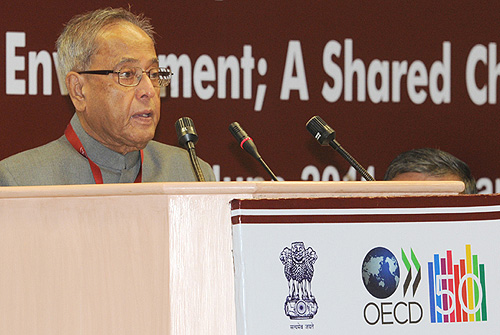
The
Finance Minister was speaking at a high-level two-day International Seminar on
“Adapting Tax Systems and International Tax Rules to the New Global Environment
: A Shared Challenge for India and the OECD”. This International Seminar is
being organized jointly by the Ministry of Finance, Government of India and
OECD. Mr. Angel Gurria, Secretary General, OECD, is also participating in the
event.
The
FM said that the rising disputes in international tax matters is another area of
challenge, which requires due attention. He said that due to linkages in global
economy, the tax disputes have assumed a multilateral character, involving
multiple countries. The present scheme of Mutual Agreement Procedure (MAP) will
be required to align to address this need, the Minister added. The Finance
Minister stated that there is a need to think of a multilateral tax convention
to address this issue of multi-polarity.
Mr Mukherjee emphasised that
tax competition driven by the presence of tax havens has created an unhealthy
situation that has helped individuals to park substantial undisclosed income
outside their countries. He said that this is also true in case of some Indian
citizens and residents, in the process denying legitimate tax revenues to the
country. He said that the Government of India has committed to vigorously pursue
all the necessary steps in coordination with countries concerned on this issue.
In the Seminar, the OECD and India announced plans to strengthen ongoing
co-operation on tax related issues through the development of a three year
partnership that will provide greater opportunities for structured dialogue and
sharing of information. The three–year programme will broaden technical
co-operation on tax matters, extend high-level policy dialogue between India,
other emerging countries and the OECD, and deepen India's participation in the
OECD Committee on Fiscal Affairs and it's subsidiary bodies, toward the eventual
goal of becoming a full participant in the Committee. It will cover a range of
issues over the coming three years, including improving tax administration,
adapting transfer pricing and tax treaty rules to the new international
environment and better understanding of the linkages between illicit flows and
tax evasion. This programme will also enable India to access OECD's work
on Tax and
Inequality, on the application of VAT/GST to cross border services and looking
at issues relating to aggressive tax planning and harmful tax practices.
|